India’s AI Healthcare Revolution Is Just Beginning — Market Expected to Touch $4.7 Billion
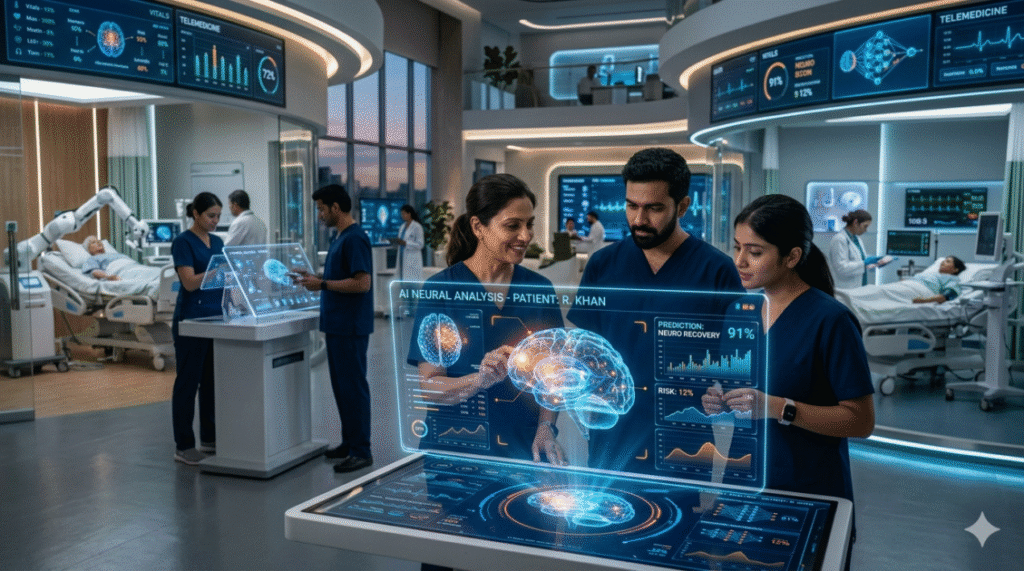
Artificial intelligence is no longer just helping people write emails or generate images — it is now preparing to transform India’s healthcare system in a massive way.

According to recent market projections, India’s AI in healthcare market is expected to reach a staggering $4.7 billion in the coming years, signaling a major shift in how hospitals, doctors, and patients will experience healthcare in the future.

From AI-powered diagnostics to smart patient monitoring systems, the healthcare industry in India is rapidly embracing technology to solve some of its biggest challenges — including doctor shortages, delayed diagnoses, rising healthcare costs, and limited access in rural areas.
Experts say this transformation is happening because India’s healthcare system is under increasing pressure. With a population of more than 1.4 billion people and growing cases of chronic diseases, hospitals are turning to AI tools to improve speed, accuracy, and efficiency.
One of the biggest areas of growth is AI-driven diagnostics. Hospitals and startups are now using artificial intelligence to analyze medical scans, detect diseases earlier, and assist doctors in making faster clinical decisions. In some cases, AI systems can even generate health assessments within minutes using smartphone-based tools.
The boom is also being fueled by India’s growing digital infrastructure. Platforms like Ayushman Bharat Digital Mission and telemedicine services are creating massive amounts of healthcare data — and AI thrives on data.
Another major reason behind the rapid growth is investor interest. AI healthcare startups are attracting strong funding as companies race to build smarter healthcare solutions for hospitals, pharmacies, diagnostics labs, and home care services. Many experts believe India could become one of the world’s fastest-growing AI healthcare markets over the next decade.
But despite the excitement, challenges still remain.
Healthcare experts warn that AI cannot fully replace doctors and human judgment. Concerns around data privacy, medical accuracy, regulations, and accessibility still need careful attention before AI becomes deeply integrated into everyday healthcare.
Even so, the momentum is undeniable.
What once sounded like futuristic technology is now slowly becoming part of everyday medical care in India — from smarter scans and virtual consultations to AI-assisted surgeries and personalized treatment plans.
And if current trends continue, the next big healthcare breakthrough in India may not come from a laboratory alone — but from artificial intelligence working alongside doctors.